The multi-level marketing (MLM) business model is one of the most lucrative business endeavors. Enterprises can create a strong network of distributors to increase product or service sales and amplify business profits with multi-stage marketing.
With the growth of digital commerce, the multi-level marketing (MLM) industry is experiencing a boom as businesses are using online platforms to expand their distributor networks and generate sales across global markets. This shift naturally brings up an important question for businesses just starting out: Can MLM software include an e-commerce platform?
.
Well, the answer is yes. Moreover, integrating an e-commerce platform into MLM software is a great approach to simplify sales and network management. Read this blog to better understand how MLM and e-commerce can work together to create a more efficient business infrastructure.
Understanding MLM E-Commerce Software
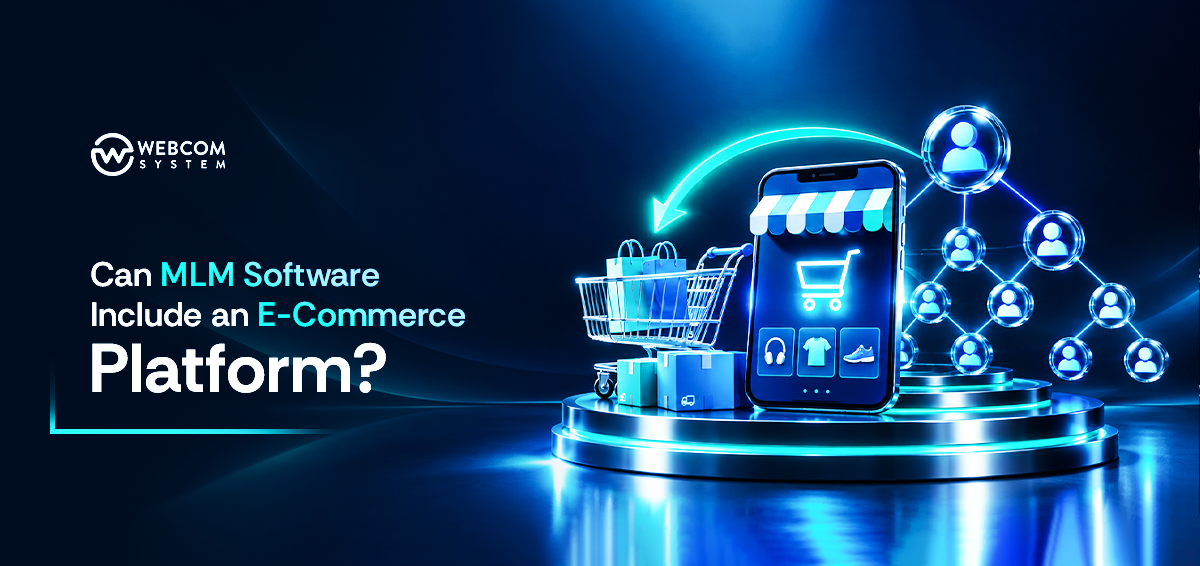
An e-commerce MLM platform is a business solution that combines the functionalities of MLM software and an e-commerce marketplace. Thus, this software program allows multi-level marketing businesses to manage and automate their business operations and also support online product sales.
The distributor network of an MLM business can sell the business’s products online and earn commissions directly through this combined platform. For example, when a distributor sells a product to the customer, this software records the transaction, automatically checks whether the sale qualifies for commissions, and makes the payment.
Hence, it cuts the need for the MLM business to manually transfer sales information from an online store into an MLM management system.
Key Features of MLM E-Commerce Platform
Professional MLM software development companies like Webcom Systems can integrate MLM software with e-commerce platforms to deliver a robust infrastructure fitted with the following features:
Product Catalog
The MLM e-commerce platform interface contains a searchable catalogue. It contains images, videos, descriptions, categories, prices, discounts, stock availability, and other key details of products. Further, all these products are linked to their specific distributors.
Shopping Cart and Checkout
Just like any eCommerce website or application, the MLM e-commerce software comes with a shopping cart feature. Customers can select and add multiple products to this digital shopping cart before continuing to checkout.
During checkout, customers can enter their name, address, coupon codes, payment mode, and contact details to get a complete cost overview with product cost, taxes, and shipping charges.
Personalized Distributor Stores
Each distributor in the MLM network can get a personalized storefront or referral URL. Hence, they can promote products through a unique link that directs customers to the business’s product catalogue. Thus, the distributor gets a commission when an order is completed through that link.
Payment Gateway Integration
An MLM e-commerce software is integrated with multiple payment gateways to process online payments. Customers can use credit and debit cards, bank transfers, digital wallets, or other supported payment methods to pay for products.
Inventory Management
The inventory management feature in these platforms allows product-based MLM companies to track stock levels of products and restock fast-moving items. Detailed product insights help distinguish between high-demand items and those that aren’t selling as quickly. It also helps prevent distributors from promoting unavailable products.
Admin & Distributor Dashboards
Both the admin and distributor dashboards are intended to improve the user experience of administrators and distributors. These dashboards provide real-time sales data, commission histories, and other details to provide precise information.
Order Management
The MLM e-commerce platform gives an overview of all pending, confirmed, shipped, processed, cancelled, and refunded orders. This allows MLM businesses to better manage their operations.
Referral Links and Tracking
The unique referral links for each distributor allow businesses to track which distributor is driving customers. This information is useful for sales attribution and compensation calculations.
Benefits Of Integrating MLM Software With An E-Commerce Platform
Clearly, e-commerce platform integration in MLM software is possible. But here comes the question: what is the actual benefit of doing so? Let’s explore the key benefits of e-commerce MLM software:
Centralized Platform
Businesses can manage distributors, products, customers, orders, commissions, and even financial reporting from the same platform. There is no need to first invest in multiple platforms and go through the hassle of switching between different ones all the time. This simplifies business administration and even reduces data duplication issues.
Plan Customization
MLM businesses can customize the platform as desired, with MLM plan options such as Binary, Unilevel, Hybrid, Matrix, or others to grow distributor chains accordingly and integrate the compensation models.
Direct Online Product Sales
MLM software with an interconnected store allows customers to browse products and complete purchases online through the same platform. This connectivity actually helps generate better sales compared to traditional distributor interactions.
More Sales Channels
Distributors can share their referral link on social media, websites, messaging platforms, and other digital channels to directly move customers toward the online store.
Referral Growth
Customers can also become brand promoters by sharing the distributors’ referral links. If the product is actually good, customers gladly recommend these products and share the distributor links to friends and family. These users receive incentives for attracting new users to the platform and increasing sales.
Automated Commission Tracking
MLM businesses involve a long chain of distributors. Tracking commission for each distributor and creating multiple spreadsheets can be extremely exhausting.
The e-commerce MLM platform offers transaction-level commission automation for businesses. The system records all the details regarding the order placement, the distributor who created that sale, the order purchased, its value, and applicable commissions.
As per the compensation plan, the MLM platform calculates the appropriate earnings automatically and creates a record of the same as well. This removes the need for maintaining spreadsheets and reduces manual errors as well.
Improved Scalability
An MLM business is designed to grow by expanding the distributor network. E-commerce MLM software can easily handle a higher volume of online transactions as the distributor network expands without causing infrastructure bottlenecks.
Conclusion
Hence, MLM software can work with an e-commerce platform, and it is indeed a powerful technical infrastructure model. E-commerce integration in MLM software creates an integrated ecosystem connecting the components of both platforms. This centralized digital environment allows customers to shop for products online and distributors and administrators to manage network operations.
At Webcom Systems, we assist businesses looking to build an MLM software solution integrated with e-commerce capabilities. Our in-house team provides custom MLM software development services, from ideation to development and beyond launch. Not only that, we have pre-built MLM solutions ready to launch with features and branding configurations in no time.
Whether you want to build a brand-new platform or upgrade your existing MLM software by incorporating an e-commerce platform, we can help you with your project. Get in touch today to launch a robust MLM e-commerce platform!
Recommended Read: Why Choose Custom MLM Software Over Ready-Made Software?