Crypto token development is not as simple as coding a smart contract! It is one of the most intricate blockchain development projects that demands a series of “right” architectural decisions to actually build powerful token ecosystems.
And oftentimes, even the most innovative token economy fails to perform during its launch due to just one small mistake. Nonetheless, despite months of hard work developing a cryptocurrency token, it is difficult to control all aspects. But! Building a solid and strong architecture can really make a big difference.
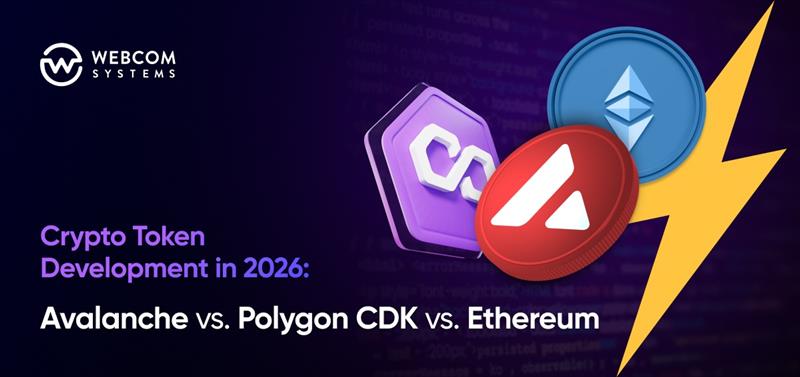
In 2026, Blockchain ecosystems like Avalanche, Polygon CDK, and Ethereum are taking the lead in the market with their own set of trade-offs. But the question remains, which one is best for crypto token development? Let’s find out!
How Does Decentralized Architecture Impact Crypto Token Development?
Blockchain is one of the most innovative but not overly new technologies. The industry has matured significantly after exploring various approaches, utilizing different tools, and learning from its mistakes and triumphs.
Based on the experiences of numerous crypto token development projects, it is clear that choosing the right ecosystem is no longer a random but purely technical and critical choice. A token coded using an unsuitable ecosystem may have poor performance, restricted liquidity, and high transaction fees, making it difficult to sustain and scale over time.
The decentralized architecture directly impacts as follows:
- Token economics: The network defines gas fees, inflation models, staking mechanisms, and incentive structures for the token. These actually shape how the token functions and retains value in the market.
- Compatibility and interoperability: Architecture determines how easily a token can integrate (or even if at all) with wallets, exchanges, decentralized applications, and other blockchain networks.
- Security: The level of decentralization, type of consensus mechanism, and validator design set the security. It is valuable for every token, but especially for high-value or institutional-grade assets.
- Compliance: Some networks are more adaptable when it comes to putting governance guidelines, tokenomics, and transfer limitations in compliance with legal requirements.
- Project delivery and maintenance: An unsuitable architecture can delay time-to-market and disrupt long-term sustainability
- Adoption: Users don’t prefer tokens operating on networks with high fees, slow transaction confirmation, and poor user experience.
- Future scalability: The underlying architecture must support ecosystem growth as adoption increases, without requiring extensive redevelopment.
Thus, when thinking beyond just launching a token and setting the right economic and technological environment for the token to thrive.
Comparison of Different Tech Stacks For Token Development
Even just in a few years, we have come a long way from just Bitcoin; we have a range of Layer-1 networks, Layer-2 solutions, modular frameworks, and app-specific chains. Let’s explore the comparison of the leading blockchain technologies for token development:
Ethereum
Although there are numerous alternative chains and Layer-2 networks, Ethereum continues to rule the market and is the preferred choice for the majority of token developers. Ethereum’s dependability actually stems from exceptional tooling, documentation, audits, and community support!
It has presented standardized token formats like ERC-20 (for fungible tokens), ERC-721 (for NFTs), ERC-1155 (for fungible, non-fungible, and semi-fungible tokens), and more for Ethereum token development. As most of these Ethereum standards are deeply embedded in wallets, exchanges, DeFi protocols, and enterprise systems, Ethereum-based tokens offer immediate compatibility and credibility.
From high security to deep liquidity and simple usability, it checks all of the boxes, making it perfect for engineering governance tokens, high-value financial assets, and institutional products.
That said, Ethereum does present minor limitations. It is not designed for high-throughput token activity, has high and frequently variable transaction fees, and has scalability limitations at the base layer. But its unmatched trust and ecosystem strength far outweigh these raw performance concerns.
Avalanche
Launched in September 2020, Avalanche is a decentralized platform and modular network that found its space in the blockchain space due to its unique Subnet architecture. This framework gives token developers great customization flexibility to create different blockchains with their own regulations, validators, and native tokens.
On top of this, one of its chains (C-Chain) is fully EVM-compatible, which allows developers to stay within the EVM ecosystem. This means that native tokens such as Gas, Governance, Staking, and incentive assets, as well as ERC-20, ERC-721, and ERC-1155 tokens, can be designed using the same development tools such as Hardhat, Truffle, etc.
Avalanche even overcomes the scalability drawback of Ethereum with its consensus design, which delivers near-instant finality and High transaction throughput. This feature makes it an ideal blockchain for crypto token development for gaming projects, DeFi platforms, and more.
Furthermore, unlike on Ethereum, the tokens operate on the protocol level rather than the smart contracts. Results? Better tokenomics control.
However, Avalanche’s unique Subnet framework requires highly detailed infrastructure planning but is far too intricate to manage even for the most skilled token developers. And liquidity, which is the most critical element for every token-based project, is much lower compared to Ethereum.
Polygon CDK
Polygon CDK (Chain Development Kit) actually represents a highly sophisticated approach to crypto token development. Stretching the customization flexibility from nearly rigid in Ethereum to high in Avalanche, Polygon CDK (Chain Development Kit) takes blockchain customization to a much greater level.
Blockchain developers employ Polygon CDK for designing highly customized and application-specific blockchains with complex token economics. Its architecture features CDK chains that can easily communicate with each other and Ethereum as well. Hence, it can power multi-chain token ecosystems and institutional-scale applications well. Here, there is an additional perk: the token ecosystem even inherits Ethereum’s premium security.
The Chain Development Kit (CDK) can be employed to create its own native gas tokens like Utility tokens, Governance tokens, etc. As they are EVM-compatible, these native tokens behave like standard ERC assets and seamlessly integrate with existing Ethereum tooling and infrastructure.
Polygon CDK heavily relies on zero-knowledge cryptography. This is why tokens launched on CDK chains have extremely low transaction fees and high throughput.
Just like Avalanche, Polygon CDK’s powerful capabilities come at a cost of high architectural complexity. Thus, it requires structured and long-term operational planning.
Comparative Overview: Ethereum vs. Avalanche vs. Polygon CDK
| Feature | Ethereum | Avalanche | Polygon CDK |
| Architecture | Monolithic L1 | Subnets & EVM chains | Modular appchains |
| Token Type | ERC-20, ERC-721, ERC-1155 | ERC + native subnet tokens | ERC + native gas tokens |
| Scalability | Limited on L1 | High | Very high |
| Fees | High and variable | Low and predictable | Very low and Customizable |
| Customization | Limited | High | Very high |
| Developer Ecosystem) | Solidity, Vyper | Solidity, Vyper | Solidity (EVM), optional zk-EVM tooling |
| Liquidity | Maximum | Moderate | Shared across the ecosystem |
| Ideal Use Case | Trust-critical assets | High-performance apps | Custom scalable ecosystems |
Summing Up
Clearly, no technology is a panacea. Whether it’s Avalanche, Polygon CDK, or Ethereum, each has its own set of distinctive capabilities that are useful in building powerful token ecosystems. So, as such, there isn’t a single one that is better than the other two; the right one just depends on what you are looking for.
At Webcom Systems, we deliver expert crypto token development services by leveraging our expertise in working with various blockchain frameworks, including Ethereum, Avalanche, Solana, Polygon, and emerging chains. Whatever the needs of your token development project, we will build robust token ecosystems using chains that suit them. Contact us today to discuss how we can help you with your project.