
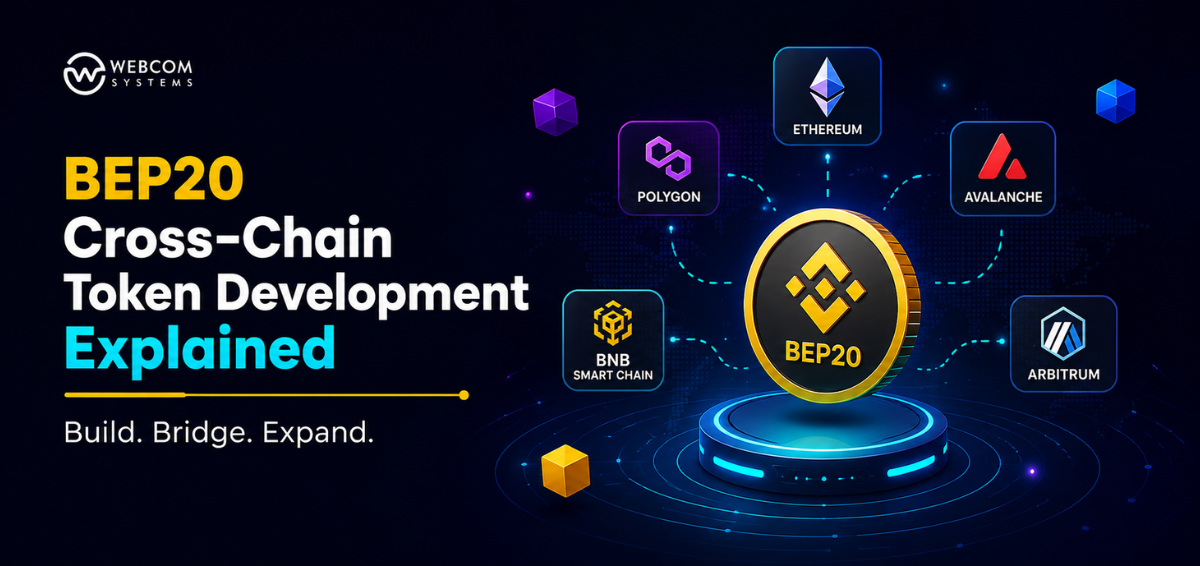
In 2026, blockchain platforms no longer work in silos! Instead, they operate as multi-chain ecosystems, where BNB Smart Chain, Ethereum, Polygon, Arbitrum, Avalanche, Base, and several other Layer-1 and Layer-2 blockchain networks can interact smoothly with one another.
The advent of cross-chain technology has allowed digital assets to move across blockchain networks effortlessly, which was never possible before. This has helped to solve all of the issues that come with traditional single-chain tokens, whether it’s liquidity fragmentation, transaction complexities, user inconvenience, or more.
Out of all the token standards, BEP20 is the most widely used token standard for developing cross-chain tokens. In 2026, BEP20 cross-chain token development is a popular choice for startups, DeFi projects, gaming platforms, and enterprise blockchain solutions looking to add interoperability to their tokens.
Read this guide to explore what BEP20 cross-chain tokens are, how they work, the development process involved, and why they are becoming important to the next generation of decentralized applications.
Understanding BEP20 Tokens
Before exploring cross-chain token development, let’s first go through what BEP20 actually is.
So, BEP20 is basically a token standard built on the BNB Smart Chain network. It serves as a template for creating a variety of tokens such as utility tokens, governance tokens, stablecoins, and asset-backed tokens.
This standard defines the rules for how tokens should be created, behave, transfer value, and interact with exchanges, wallets, smart contract systems, and decentralized applications.
Key Benefits of BEP20 Token Development
Although the BNB Smart Chain’s BEP20 standard functions very similarly to Ethereum’s ERC20 standard, they have better perks like low fees, fast transaction speed, and more, as explained below:
Quick Transaction Processing
Speed is an important facet that makes BEP20 tokens popular in the Web3 space. They process transactions much more quickly, which is extremely beneficial for platforms where user experience matters the most, such as DeFi applications, NFT marketplaces, and real-time gaming environments.
Lower Transaction Costs
The low transaction fee of Binance Smart Chain is typically around $0.26 per transaction. It is far less than that of the most popular networks. This helps operational expenses for both businesses and users.
Compatibility With Ethereum Tooling
As Binance Smart Chain is compatible with Ethereum, developers can easily employ Ethereum-based development tools and infrastructure such as Solidity, Hardhat, Remix, and OpenZeppelin libraries.
This compatibility is particularly useful in project migration, reusing existing components, and integrating with existing infrastructures with minimal development complexity.
Strong Ecosystem Support
The BNB Smart Chain ecosystem can support decentralized applications, exchanges, wallets, staking platforms, liquidity protocols, and more. Hence, these BEP20 tokens can easily gain utility and market exposure without carrying extensive infrastructure developments.
Flexible Tokenomics
It is much easier to configure the tokenomics of BEP20 tokens, such as deflationary mechanisms, transaction taxes, staking rewards, vesting schedules, liquidity incentives, and so on.
While all of the capabilities of the BNB Smart Chain are extremely valuable, traditional BEP20 tokens remain limited to their native blockchain until interoperability is intentionally introduced through cross-chain token development.
What Are Cross-Chain Tokens?
As the term suggests, a cross-chain token is basically a digital asset that is designed to operate across multiple blockchain networks. Hence, they can easily move between networks such as BNB Smart Chain, Ethereum, Polygon, Avalanche, Arbitrum, Base, Optimism, and more.
It is especially made sure that these cross-chain tokens maintain their consistent value and supply model even as they move across different ecosystems.
But how are these tokens provided with this compatibility?
Tokens can be provided with cross-chain functionality through different mechanisms such as bridging, minting, locking, message-passing protocols, wrapped assets, omnichain token frameworks, and more. These mechanisms help ensure that the token can be transferred, represented, or synchronized across different chains without actually losing its utility.
Why Does Cross-Chain Token Development Matter In The First Place?
Cross-chain token development is becoming widely popular, particularly with the BEP20 standards leveraging valuable features of Binance Smart Chain.
In 2026, the Web3 landscape has evolved into a multi-chain environment. Digital assets should be interoperable to allow token owners to hold them across multiple platforms that support different blockchain networks.
If the project lacks this functionality, it causes the following issues:
Fragmented Liquidity
Without interoperability, liquidity becomes dispersed across multiple platforms. This results in limited liquidity, which directly reduces trading efficiency and market depth.
Limited Reach
Because a token can only operate on a single platform, it restricts access to users within that ecosystem.
Reduced Utility
Tokens are restricted to one blockchain due to a lack of interoperability, which also limits integration opportunities across DeFi platforms, NFT marketplaces, gaming applications, and enterprise solutions.
Scalability Constraints
As tokens can move across the same blockchain, the network congestion becomes normal. Hence, projects need the flexibility to leverage alternative chains for lower costs and higher throughput.
Cross-chain BEP20 tokens address none of the above issues and deliver a unified asset experience across multiple networks.
Step-by-Step Process of BEP20 Cross-Chain Token Development
Building a BEP20 cross-chain token requires a lot more than creating a standard token on BNB Smart Chain, as it also requires developing a secure interoperability framework for seamless interaction across multiple blockchain networks. Below is a step-by-step breakdown of the development process.
Define the Token’s Purpose and Tokenomics
The first and foremost step in developing a token is to define the token’s goal and economic model. A well-planned tokenomics model will clarify how the token will be used, whether for payments, staking, rewards, or another purpose.
Develop the BEP20 Smart Contract
After selecting a token model, blockchain developers would use the Solidity programming language to create the BEP20 smart contract on the BNB Smart Chain. This contract would handle the token’s functionality, including token transfers, balance management, security mechanisms, ownership controls, minting and burning capabilities, and more.
Select the Cross-Chain Infrastructure
In this step, from options such as Blockchain bridges, Cross-chain messaging protocols, Omnichain token frameworks, or others, a cross-chain infrastructure is selected to decide how the token will communicate with other blockchain networks.
Design the Cross-Chain Infrastructure
Now, the selected interoperability framework is built to allow token exchange across different chains. The developers would design a strong architecture by specifying the source and destination chains, supply management model, transfer validation mechanisms, communication protocols, and security controls.
Once the architecture is established, Blockchain developers will integrate a bridge or interoperability protocol to provide the token with cross-chain functionality.
Deploy Smart Contracts on Supported Chains
Along with the primary BEP20 token contract, different token contracts are deployed on each blockchain, such as Ethereum, Polygon, Avalanche, or more, to support the assets across these chains.
Establish Cross-Chain Communication
At this step, the interoperability layer is configured to allow secure communication between blockchain networks. This configured communication framework would manage token transfers, data exchange, governance actions, etc.
Implement Security Mechanisms
The whole token ecosystem is secured by incorporating multi-signature controls, Validator networks, role-based permissions, emergency pause features, and more to protect against unauthorized access and potential vulnerabilities.
Rigorous Testing
Before launch, the entire infrastructure is passed through multiple testing procedures to identify and resolve potential issues. These testing procedures include smart contract audits, functional testing, stress testing, cross-chain transfer testing, security assessments, and many more.
Deploy and After-Launch Support
Once any spotted vulnerabilities are removed, the token and its cross-chain infrastructure are finally deployed to the mainnet.
But the cross-chain development does not end after launch. The token ecosystem is monitored at all times to carry out security optimizations or provide necessary feature updates.
Conclusion
In 2026, BEP20 cross-chain token development is assisting in building more connected Web3 ecosystems. While the BEP20 standard offers perks like fast transaction processing, low fees, and strong ecosystem support on BNB Smart Chain, integrating cross-chain functionality allows them to operate seamlessly across multiple networks. That’s why cross-chain BEP20 tokens can be employed for DeFi, gaming, and enterprise applications, and they are becoming an essential component of modern Web3 platforms.
Webcom Systems is a globally leading blockchain development company that helps businesses launch BEP20 Cross-Chain Tokens that operate seamlessly across multiple networks. Whether you want to create a new cross-chain token or improve an existing blockchain project with cross-chain functionality, we can provide custom cross-chain token solutions for long-term growth and success, assisting from concept to launch. Get in touch today to discuss your project!
Recommended Read: Crypto Token Development in 2026: Avalanche vs. Polygon CDK vs. Ethereum