
Cryptocurrency, which was once deemed just a passing fad, has earned a major role in the financial ecosystem. Currently, the impact of this digital currency is huge, to the extent that it is influencing investment strategies and reshaping payment systems worldwide.
But the infrastructure that gave crypto coins a central stage and helped them move from a niche market to a global asset class is none other than cryptocurrency exchanges. Over the years, even these crypto exchange platforms have also grown from simple marketplaces to sell and buy cryptocurrencies.
In 2026, taking experience beyond simple spot trading, crypto trading venues have become intelligent and secure ecosystems that offer derivatives, futures, options, perpetual contracts, and much more.
If you’re thinking about starting your own crypto exchange, clearly, you will need to launch a powerful and modern Crypto trading venue that has the right capabilities. Read this blog to understand what features your platform would need in 2026 to fulfill the expectations of traders and stand out from other exchanges. But first, what makes a software crypto exchange platform?
Understanding a Crypto Exchange Platform
A crypto exchange, also called a digital currency exchange (DCE) platform, is basically a marketplace where individuals can buy, sell, and trade digital currencies like Ethereum, Solana, BNB, XRP, and more.
Acting as intermediaries, crypto exchange platforms connect the users directly to the matching engine, place orders on behalf of buyers with sellers, and carry out secure transactions in real time. You can think of them as similar to stock exchanges, but the key difference is that they carry the buying, selling, and trading of digital assets.
Crypto exchanges are typically accessible through:
- Web-based platforms that users can access via desktop browsers
- Mobile applications available on iOS and Android devices
Depending on their infrastructure, crypto exchanges can be categorized into various types. Here are the main model categories:
Centralized Exchanges (CEXs):
These exchanges are operated by parent firms that manage trades, custody for funds, user accounts, order books, and more. High-value traders trust CEXs for their speed and regulatory compliance.
Decentralized Exchanges (DEXs):
Intermediaries do not operate these platforms. Hence, they support peer-to-peer trading directly, basically through automated smart contracts. DeFi enthusiasts prefer DEX platforms due to their decentralized finance features.
Hybrid Exchange Model
As the name implies, hybrid exchanges combine elements of centralized infrastructure and decentralized features. Professional and retail traders prefer these exchange platforms because they offer decentralized self-custody, regulatory compliance, and risk management in a single ecosystem.
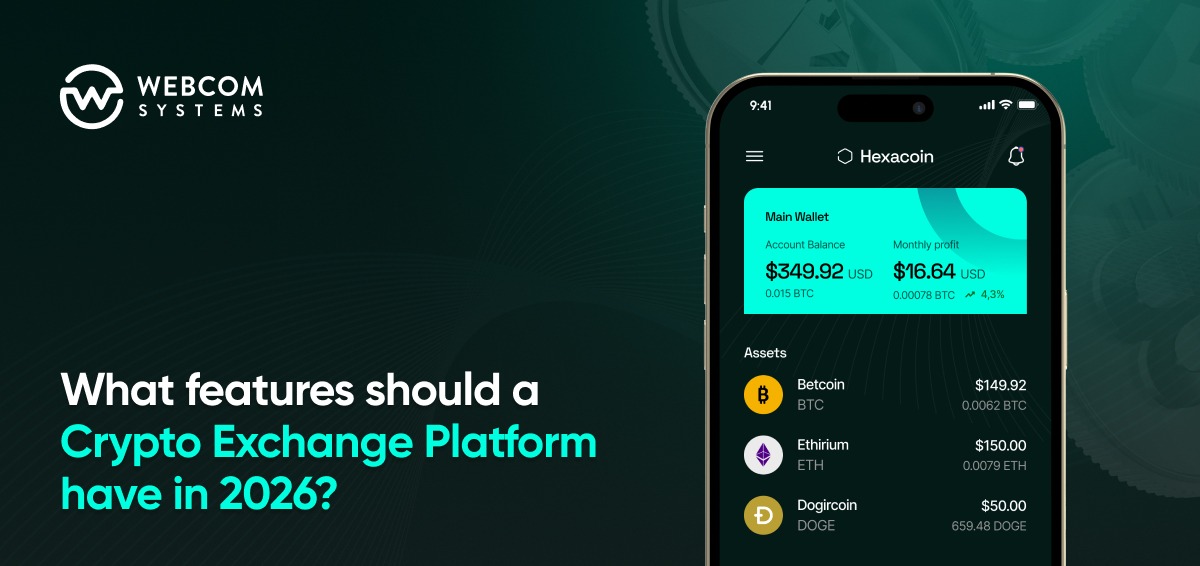
Modern exchanges, regardless of model, have user-friendly dashboards with features such as real-time price charts, trading tools, KYC/AML systems, wallet integration, security features, and more.
Key Features Of Modern Crypto Exchange Platforms In 2026
With the emergence of new technological trends in the space and increased global adoption, cryptocurrency exchange development platforms have evolved dramatically in recent years, creating opportunities for investors and traders.
Crypto exchanges in 2026 will be shaped by emerging technologies, trends, and user expectations. Modern platforms must go beyond basic trading functionality and feature distinct capabilities such as:
High-Performance Matching Engine
The matching engine defines the core trading infrastructure of every crypto exchange platform. The modern matching engine should be able to actually serve countless users at a time with microsecond-level order processing, even during periods of high market volatility.
Additionally, a modern matching engine should support a wide range of advanced order types, including market orders, limit orders, stop-loss orders, trailing stop orders, OCO orders, and other order types to execute diverse trading strategies for active trading.
Deep Liquidity and Aggregation
Exchange platforms need liquidity for smoother buying and selling of assets without causing significant price fluctuations. To deliver such deeper internal liquidity pools, the exchange must combine liquidity from multiple Tier-1 liquidity providers with advanced liquidity aggregation systems. Smart order routing and aggregation mechanisms widen bid-ask spreads while reducing order slippages and offering smooth trade execution even in volatile market conditions.
Also, in 2026, exchange platforms must extend beyond spot markets and also into derivatives and perpetual futures markets. This would help the platform support growing demand for leveraged and institutional-grade products.
Intuitive UI/UX Design
With evolving trading strategies and asset classes, crypto trading is becoming more complex and demanding advanced trading skills. Hence, the cryptocurrency trading platform does not need to be overly confusing to operate and overcomplicate the whole experience for users.
The crypto trading platform should have a clean dashboard that allows easy navigation for both beginner and pro traders to eventually offer them a simplified onboarding experience. Furthermore, it should include features such as TradingView charts, one-click trading, mobile access, and voice support to purposefully oversimplify the platform.
Advanced Security Protocols
Security of any software is critical. When the software serves a global client and manages multiple financial transactions, platform security, such as that of a cryptocurrency exchange, becomes even more important.
As a result, to avoid cyberattacks and data breaches, exchanges must proactively safeguard funds and data with multiple layers of security. This multi-layered security architecture may include multi-signature wallet authorization, two-factor authentication (2FA), biometric login, end-to-end encryption, DDoS mitigation, and zero-knowledge proofs. Additionally, using AI-powered fraud detection systems can help detect anomalies before they cause security breaches and financial losses.
Regulatory Compliance and Legal Readiness
Regulatory compliance has never been optional, but it is the key feature that is required to operate exchanges legally and avoid penalties, restrictions, or closure.
In 2026, regulatory oversight in international markets continues to be more intense. It is critical to have proper licenses from the necessary jurisdictions in order to carry out lawful operations and establish a reputation for reliability.
Besides, exchanges must embed compliance frameworks fundamentally into their infrastructure, such as biometric or selfie verification, automated KYC processes, and continuous AML monitoring supported by advanced compliance tools such as Sumsub or Chainalysis. Exchanges should also provide cryptographic proof of reserves, Independent audits, and maintain reporting of liabilities and assets.
Multi-Chain and Cross-Chain Compatibility
Decentralized exchanges need to support multiple blockchain networks, whether it’s Ethereum, Litecoin, Solana, Cardano, BNB Chain, or something else. This capability allows users to trade seamlessly across different asset classes. By incorporating cross-chain bridges or other strategies, platforms can facilitate cross-chain transfers effectively.
Real-world asset support
Crypto exchange platforms do support popular crypto coins, as this is the primary function of these platforms. However, as Real World Asset Tokenization (RWA) has grown in popularity, the platform must support tokenized assets such as real estate, commodities, and equities in order to diversify its offerings and attract institutional participants.
Advanced Charting and Technical Analysis
In 2026, crypto exchanges must cater to both beginners and professional traders within a single ecosystem. This could help them serve a diverse user base and also ease the customer experience as well.
Moreover, exchanges should minimize reliance on third-party charting platforms by offering built-in professional-grade tools, including Multiple timeframes, Technical indicators, Drawing tools, Volume and depth charts, Custom alerts, and watchlists.
AI trading bots for Algorithmic Trading
Algorithmic trading has definitely become standard practice among institutional and high-frequency traders. They can make great returns on their cryptocurrency investments by using AI-powered trading bots to practice sophisticated trading strategies, such as high-frequency trading, with little effort.
A robust API setup in the exchange platforms can give professional traders simple access to AI-powered trading bots. Thus, these platforms must provide a reliable API infrastructure that includes low-latency endpoints, WebSocket feeds for real-time market data, and sandbox environments for testing trading strategies.
Derivatives and Advanced Trading Products
The crypto market has matured a lot. Now, experienced traders are increasingly seeking advanced instruments such as perpetual futures, options trading, margin trading, and structured investment products. In 2026, modern exchanges must support these sophisticated trading options for derivatives markets alongside spot trading.
Wrapping Up
In 2026, the world has moved way past the time when there were questions around trading in cryptocurrencies. Much more like stocks, digital currencies are trusted due to a secure, compliant, scalable, and innovative financial ecosystem powered by crypto exchange platforms. These platforms are no longer just venues for trading; they have evolved into reliable and feature-rich marketplaces that serve both retail and institutional traders.
At Webcom Systems, we help businesses build next-generation, feature-packed crypto exchange platforms using the leading tools and technologies and industry-standard development practices. Interested in knowing more about how our crypto exchange development services are fueling the next phase of digital finance evolution? Contact us today!
Recommend Read: Tokenization in Crypto Exchange Development: Why It Matters