The foreign exchange market is one of the most thriving financial sectors, finalizing almost $9.6 trillion in trades per day. Not only is this true, but this volume is going up at a remarkable pace. Clearly, trading platforms that support these markets have to also advance to keep pace with this growth and meet the modern demands of speed, accuracy, and security.
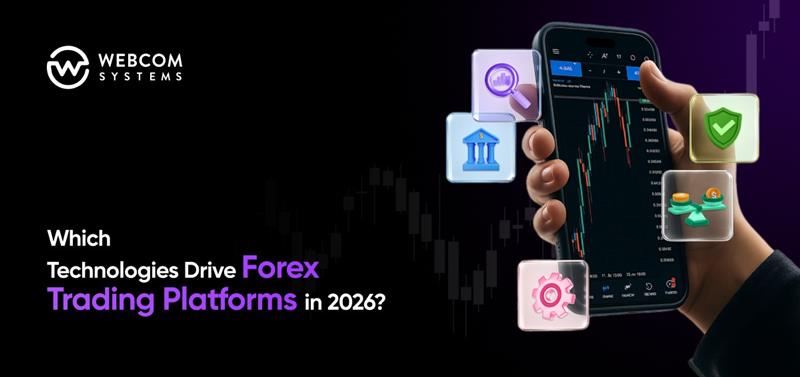
In 2026, Forex trading platforms feature one of the most technologically advanced financial ecosystems ever built. These platforms are not only providing connectivity to forex markets but also setting new standards of performance and reliability. That’s only since trading infrastructure providers began incorporating nearly every emerging technology, such as artificial intelligence and blockchain, to power modern forex trading systems. Read this article until the end to learn about the key forex trading software technologies and explain how each contributes to speed, security, and innovation.
Tech Stack for Forex Trading Platform Development in 2026
A forex trading ecosystem consists of a core technological infrastructure, servers, and networks that connect liquidity services, brokerages, traders, and investors. The forex trading platform architecture is actually built with a multi-layered set of technologies, each of which provides and supports the platform’s functionality. As each layer supports a specific function, this rich technological stack forms the operational backbone of the forex platform and handles user interaction, backend processing, and infrastructure management.
Today, trading systems are powered by the following sophisticated technologies to offer an institutional-grade architecture that drives innovation and enhances the speed, functionality, and security of the platforms:
Artificial Intelligence and Machine Learning
In 2026, Artificial Intelligence (AI) has left no sector untouched, and the forex trading ecosystem is no exception. Without even bragging, AI has become a standard feature of most advanced forex platforms.
Developers integrate AI technologies to empower trading systems with high-end capabilities, whether it’s automated execution, fraud detection, or practicing advanced trading strategies such as arbitrage, algorithmic trading, and high-frequency trading.
Trading bots have basically become personal assistants for traders. They can analyze price variations across different forex markets and execute trades in real-time, as per set conditions, and even consider the risk parameter. These tools can even measure the liquidity and manage order routing to execute trades efficiently and automatically.
Basically, Artificial Intelligence takes away human emotions and errors from the trading and helps make data-based, accurate, and on-time decisions on behalf of humans. The best part is that these AI solutions use machine learning technology to learn, improve, and adapt to get better over time.
Cloud Computing and Distributed Infrastructure
Nowadays, modern platforms don’t employ traditional server-based infrastructure, as they use distributed cloud environments. This actually helps to reduce reliance on centralized servers while also increasing reliability and accessibility globally. These platforms can automatically allocate additional computing resources to adapt during periods of high volatility. This directly helps reduce latency and improve order execution accuracy.
Big Data Analytics
Big data analytics integration in forex platform development is delivering excellent results. Actually, the forex industry handles a large amount of data that varies across each currency market, making it difficult for traders and investors to truly comprehend it.
Big data analytics systems in trading platforms can easily analyze data from different sources, such as historical price data, market news, economic indicators, trading behavior, and more. They easily process this information in a matter of no time and provide actionable insights to make data-driven trading decisions.
Cybersecurity and Data Protection
Security is the unspoken necessity for every technology platform. Though supporting a highly lucrative market, forex trading platforms are the most popular targets for cybercriminals. Thus, modern platforms are equipped with high-end security technologies, such as multi-factor authentication (MFA), end-to-end encryption, intrusion detection systems, AI-based threat monitoring, secure identity verification, and many others.
These multi-layered security systems help brokerages in spotting the suspicious patterns in user activity and transactions. These trigger actions way before damage occurs, whether it’s further evaluation, account blocks, or reporting to authorities, depending on the risk parameters. Thus, cybersecurity ultimately protects user funds, shared personal or financial data, and platform integrity.
Blockchain and Distributed Ledger Technology (DLT)
Blockchain technology uses a distributed ledger across a network of nodes to store transactions transparently and securely. Manual processes can be automated by smart contracts, defined by their execution conditions, and reading systems that allow secure and transparent transaction logging. Brokerages, liquidity providers, and clearing firms can easily verify transactions on the chain, thus preventing conflicts. Additionally, all the manual processes can be processed by smart contracts by defining their conditions for execution. This helps speed up transactions and lowers expenses.
Top Frontend and Backend Development Frameworks
Platform functionality is actually the deciding factor in whether a trader wishes to continue using the platform. That’s why the best frontend frameworks and backend technologies are being leveraged in forex broker software development to deliver seamless, fast, and reliable trading experiences.
Developers who specialize in building enterprise-grade trading ecosystems typically incorporate front-end frameworks like React, Angular, or Vue.js. On the backend, they often use programming languages such as Python, Node.js, Java, and low-latency C++ services and PostgreSQL, MySQL, MongoDB, and Redis caching to handle data storage.
Regulatory Technology (RegTech)
Although that’s not something new, brokerages need to comply with financial regulations to operate trading businesses legally and securely. These regulations are intrinsically complex and always changing, which makes compliance challenging.
RegTech tools actually help brokerages in complying with their platforms with complex financial regulations without manual intervention. These automated modules can handle KYC (Know Your Customers), AML monitoring, transaction reporting, and compliance audits. This not only makes it easier to meet compliance requirements but also improves market reputation and instills trust in users and investors.
Liquidity Aggregation Technology
Liquidity aggregation systems are being used in trading platforms to get the best available prices of assets across multiple sources, such as Tier-1 banks, Tier-2 banks, non-bank liquidity providers, electronic communication networks (ECNs), etc. They can analyze price feeds and choose the optimal execution paths for fetching maximum profits for traders.
API-Driven Architecture
Modern forex trading platforms are designed with API-first architecture. This helps seamlessly integrate different components, such as trading APIs, payment gateway APIs, risk management APIs, liquidity provider APIs, market data APIs, and more. This modular architecture eventually improves the functionality of the trading ecosystem without interfering with the core trading engine.
Conclusion
Modern trading platforms are backed by futuristic technologies, where artificial intelligence takes the lead and is supported by cloud computing, blockchain, APIs, liquidity aggregation, and cybersecurity systems. These systems can easily process thousands of trades in real time as well as offer user-friendly experiences.
We at Webcom Systems integrate emerging technologies in forex trading software development to empower brokerages with sophisticated ecosystems that remain competitive in the ever-changing forex market. We provide white-label solutions as well as create custom platform development support right from scratch using the most advanced forex platform tech stack. Interested in knowing more about our services? Get in touch today!
Recommended Read: What Are the Key Features of an FX Trading Platform?