
By 2026, blockchain has deepened its roots in every major sector, whether it’s healthcare, logistics, finance, e-commerce, real estate, entertainment, or whatever else. Intriguingly, even the government services sector and traditional banking institutions are employing this transformative technology, primarily for its value in improving legacy models and creating new opportunities.
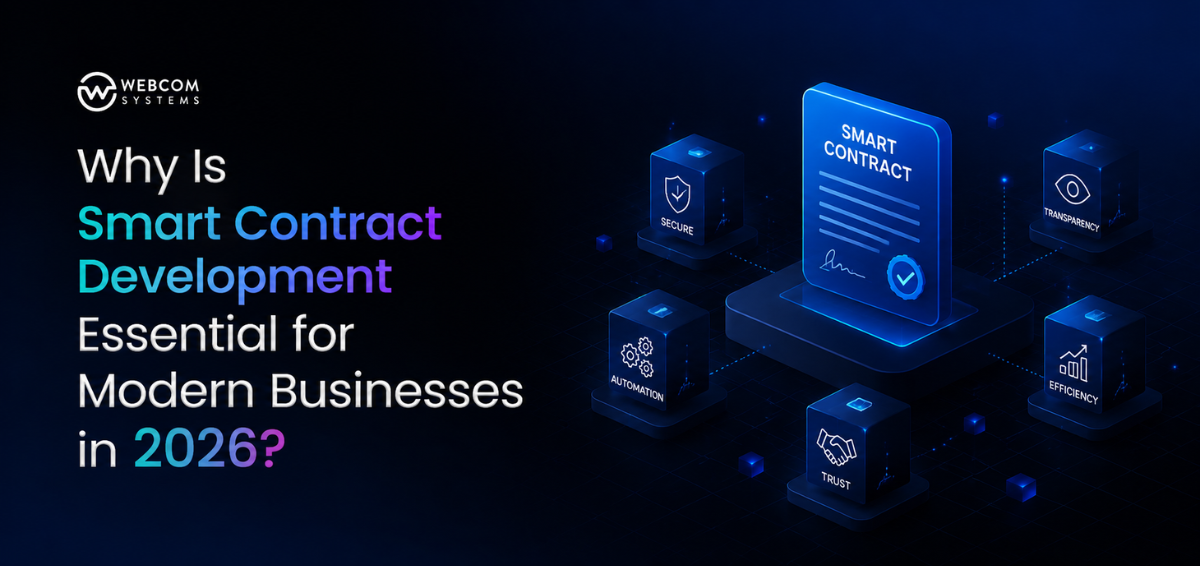
The core technological infrastructure behind blockchain that gives it the power to deliver real-world business applications is smart contracts. Certainly, these digital agreements are driving blockchain innovation among global industries and delivering decentralization, transparency, security, trust, privacy, and, of course, automation and business efficiency. Let’s explore in detail why businesses are investing in smart contract development by covering the benefits of these digital agreements.
Understanding Smart Contract Development
Smart contract development is the complete process of building and deploying digital agreements on the blockchain network. These blockchain-powered agreements are coded with their exact conditions for executing transactions or taking some other actions automatically.
Thus, unlike conventional agreements, they are not written on paper or managed manually by involving multiple parties. The key quality that differentiates them is that they operate autonomously and transparently.
This concept was presented by cryptographer Nick Szabo in 1994, surprisingly even before cryptocurrencies came along. But after Ethereum came, smart contract creation came into the picture.
Professional smart contract development companies like Webcom Systems follow a structured process to engineer these contracts, which involves ideation, design, development, testing, security auditing, deployment, integration, and ongoing maintenance.
How Smart Contracts Actually Operate
Smart contracts are often described as a “digital vending machine” because they work like one. The machine is set with if/when…then… rules, and when these conditions are met, it automatically releases the product. But that’s just the basic flow; here’s the exact mechanism behind their operation:
- Smart contracts are coded on the blockchain network, primarily Ethereum, using the Solidity programming language, mentioning terms and conditions.
- Once deployed, the smart contract is stored at a specific address on the blockchain network.
- The contract continuously monitors whether the specified conditions have been met.
- As soon as the conditions are met, the contract takes action, such as making payments, updating records, transferring ownership of an asset, and so on.
- Once executed and recorded on the blockchain, this contract becomes immutable.
Key Properties of Smart Contract Solutions
Here are the key features that give smart contracts the strength to create impact in the real world:
Self-Executing
Blockchain-powered digital agreements deploy on their own once the set conditions are met. They do not require third-party approval or interference.
Tamper-Proof
These contracts can be changed after they have been deployed on the blockchain network. This makes them resistant to tampering and post-agreement edits.
Transparent and Auditable
The code for smart contracts and all of the transactions they process is stored in the blockchain. Hence, they are open to inspection, verification, and auditing by authorized parties.
Decentralized and Secure
Smart contracts run on decentralized blockchain networks. Thus, they acquire the key decentralization feature, which makes them secure from single points of failure and censorship.
Benefits Of Smart Contract Development For Modern Businesses
While we have gone through what smart contracts are and the key capabilities of these agreements, what makes them a worthwhile business investment? Let’s find out!
Business Automation and Efficiency
Automation delivered by smart contracts is something that creates curiosity among businesses eager to innovate their legacy systems that rely on human intervention, numerous approvals, and copious amounts of paperwork.
Smart contracts can manage these business operations and completely remove the need for manual management or involve a long network of intermediaries. This, of course, speeds up the incredibly slow procedures like insurance claims, supply chain operations, and remittance payments. Moreover, automation leaves no room for accidental human errors as well.
Minimise Fraud and Enhance Trust
Digitizing agreements doesn’t need to come at the cost of exposing sensitive information to cyber threats and data breaches with smart contract implementation. Smart contracts, which are built on blockchain technology, use cryptographic techniques. This makes tampering with the data difficult. Once these contracts are deployed on the blockchain network, any information related to the agreements cannot be changed or deleted. Hence, this directly reduces the likelihood of fraud. It also removes the chance of disagreements, as they can be reviewed for terms and execution history.
Cut Operational Costs
Smart contracts literally cut the operational costs that come with involving third parties and manual documentation due to their incredible automation capabilities. For example, processing claims, making international payments, confirming identity, and other tasks can be handled at much less expense when processed automatically. This makes the operations more affordable for businesses and the services less expensive for customers.
Thus, the initial cost of investing in smart contract development pays for itself in the long run by increasing the business’s return on investment (ROI).
Adopting New Business Models
Smart contracts do more than just alleviate long-standing bottlenecks for businesses. They have created new business models that are opening amazing opportunities for enterprises.
These contracts serve as the foundation for the development of decentralized finance (DeFi) platforms, NFT marketplaces, tokenisation platforms, automated subscription services, blockchain-based loyalty programs, DAO solutions, and decentralized applications (dApps).
Key Sectors Exploring Smart Contract Development In 2026
But here comes the question of which global sectors benefit from smart contracts. To put it simply, every industry that deals with agreements, transactions, or both on a daily basis can improve its manual processes by switching to blockchain-powered digital agreements. Here’s how:
Finance and Banking
Both the finance and banking sectors were looking for a way to automate their manual document management and increase operational efficiency. This made smart contracts an excellent fit for these sectors.
Through smart contract engineering, financial businesses and banks can create automated lending platforms, simplify cross-border payments, carry out peer-to-peer (P2P) transactions, implement automated escrow services, and develop innovative blockchain-powered financial solutions.
Supply Chain Management
Businesses in the supply chain frequently struggle with the complexities of keeping a record of the product journey. Manual management often leads to inefficiencies, inaccuracies, and uncertainties.
By implementing smart contracts in the supply chain, businesses can easily create a complete track of the products from their origin to distribution, creating complete transparency. These agreements work automatically to manage operations such as payment processing, quality checks, and so on.
Real Estate
Every real estate transaction often has to go through multiple intermediaries, which obviously slows down the process, raises costs, and creates multiple vulnerability points.
Smart contracts can manage these transactions without the need for a mediator, making it easier to transfer properties, enforce rental agreements, make escrow payments, process lease renewals, distribute rental income, verify property records, and perform other operations. Most importantly, these agreements support the fractional ownership of real estate assets.
Healthcare and Pharmaceuticals
The proliferation of patient data makes it challenging to manually handle the data for healthcare service providers and also maintain the security of the sensitive information.
In healthcare, these blockchain-powered digital contracts carry secure sharing of patient records, automate insurance claims processing, manage clinical trial data, and simplify medical billing and payments. Not only that, but smart contracts also help pharmaceutical companies create a complete track of the drug journey to combat counterfeit medicine issues.
Clearly, this helps to maintain privacy, minimize fraud, reduce administrative overhead for healthcare providers, and improve overall healthcare services for patients.
Legal Sector
Smart contracts, when employed to automate legal documents, are termed “Ricardian contracts.” Basically, it requires writing legal prose with code and automating contract enforcement on meeting coded conditions.
While this, of course, cuts the manual workload, it also helps maintain trust with digital ledger recordkeeping and reduces legal disputes.
Wrapping Up
Indeed, after going through all of the major capabilities of smart contracts, the question isn’t what smart contracts can do but what they cannot do. From healthcare to law, finance, banking, or anything else you can name, these digital agreements are helping instil key functionalities of blockchain and bringing digital transformation.
But here’s the truth: no matter how amazing these blockchain solutions are, developing them takes years of industry knowledge, specialized expertise, and, yes, extremely sophisticated technical resources.
That is why working with a professional blockchain development company, such as Webcom Systems, is the ideal choice when developing smart contracts for your business. Since 1998, we have been helping businesses implement innovative technologies to improve their business operations. We provide end-to-end blockchain smart contract creation services, from conceptualizing the solution to the technology section, designing the architecture, coding smart contracts, carrying out smart contract audits and optimizations, and finally launching your digital agreements. We have helped numerous business clients across over 30 sectors to actually benefit from smart contract automation by developing secure and well-audited smart contracts for their enterprises.
Whether you want to build smart contracts for a token, a multi-chain NFT marketplace, or something else, contact us to help you with your project!
Recommended Read: How Much Does Smart Contract Development Cost In India?