
Blockchain technology is no longer limited to Bitcoin, Ethereum, or related cryptocurrencies. In 2026, one of its key applications, Real World Asset Tokenization, became the hot topic of conversations among tech innovators, financial institutions, and business leaders. Not only that, but the asset tokenization market is just taking off. The estimated market value of around USD 3.01 trillion in 2026 is projected to reach USD 18.74 trillion by 2031.
This RWA tokenization is actually making waves by creating structural changes and solving real-world financial and operational gaps across gigantic industries. It works by bridging blockchain technology and traditional finance. Tokenization digitizes valuable real-world assets by bringing them on-chain and making ownership more accessible, transparent, and yes, profitable. But there is much more to this!
This article will cover an in-depth analysis of how different industries stand to benefit from RWA tokenisation development due to the nature of their assets and existing market inefficiencies.
Understanding RWA Tokenization
RWA tokenization is the process of defining physical or traditional financial assets on the blockchain’s distributed ledger. This strategy essentially converts ownership rights of real-world assets into blockchain-based digital tokens. Hence, tokens simply represent a verifiable share or claim of an underlying asset such as real estate properties, commodities, bonds, private equity, invoices, intellectual property, and even carbon credits.
This digitization of real-world assets makes value fluid and programmable, as well as completely changes the way these assets are managed and traded. The most intriguing thing is that RWA tokenization allows regulatory frameworks to control the economic and legal rights of these assets. This occurs by integrating compliance layers into token issuance frameworks.
Benefits of Real-World Asset Tokenization
Here are some of the ways RWA tokenization platform development benefits by improving asset management and investment, as follows:
Increased Transparency
Blockchain technology creates a transparent and reliable ownership record of all the transactions related to the tokenized assets.
Fractional Ownership
High-value assets can be divided into small-value tokens to increase investor participation.
Improved Liquidity
Digital tokens can be traded easily and hence are more liquid than their traditional counterparts.
Automate Transactions
Smart contracts governing these digital tokens help to automate processes. This directly reduces paperwork, cuts infrastructure costs, and speeds up transfers.
Global accessibility
Where real-world assets face geographical limitations, tokens can be accessed by investors worldwide.
Industries That Benefit Most From RWA Tokenization Development
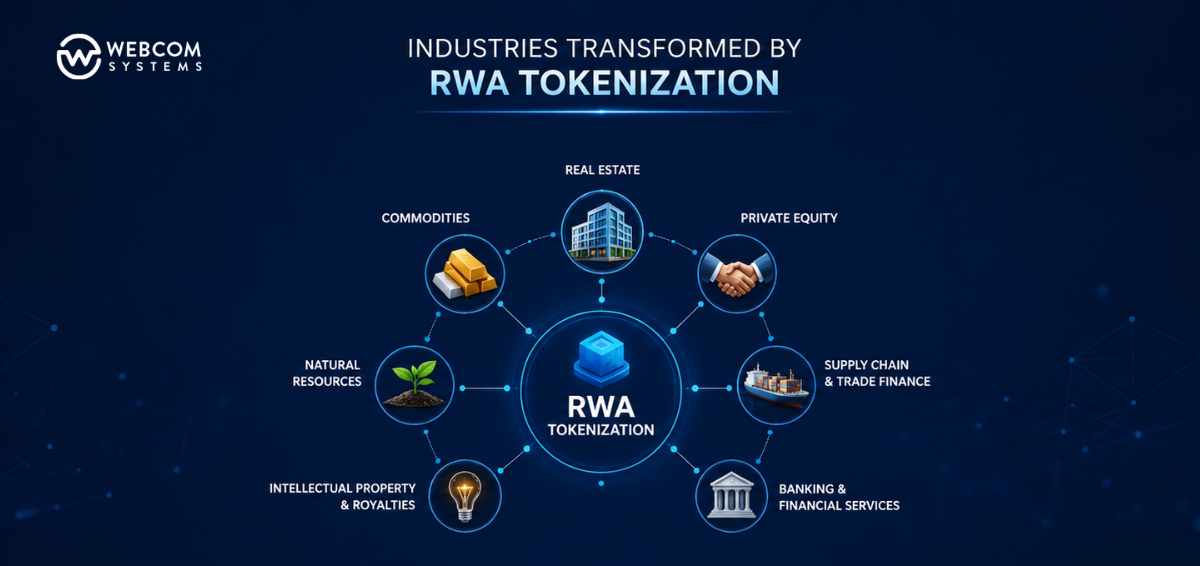
RWA tokenization is redefining how industries employ real-world assets, as well as creating new opportunities by increasing liquidity, allowing fractional ownership, and providing global access, and much more, as explained as follows:
Real Estate
Real estate is by far the most popular use case and beneficiary sector for RWA tokenization.
Property markets struggle with issues like excessive paperwork and extra-long settlement periods due to manual record-keeping and settlements. Furthermore, real estate properties, especially high-value properties such as luxury homes and commercial properties, are prohibitively expensive for investors on a low budget.
Real-world asset tokenization platform development operates by modifying the legacy operational model and dividing expensive properties into more affordable multiple fractional ownership units. Thus, small-scale property investors can own smaller portions of commercial offices, residential developments, hotels, or rental portfolios that perfectly fit their budget. Plus, the High-Net-Worth Investors (HNWIs) can invest in several different property types to diversify their portfolios and reduce risk exposure.
This broader accessibility ultimately benefits real estate businesses in attracting a larger and more diverse investor base. Moreover, the smart contract automation helps them reduce the complexities of manual record-keeping, align legal structuring, and maintain compliance. The transparency of blockchain-based digital registries and escrow contracts makes it even easier to verify and audit compared to fragmented legacy systems.
Private Equity and Venture Capital
Although Private equity markets are highly lucrative, they are known to be a market suited for HNWIs and large-scale property investors. This is mainly due to high investment thresholds and limited liquidity.
What this means is that this market demands investors put in large amounts of capital and be patient for years before exit opportunities arise. RWA tokenization services work precisely in this industry by introducing more flexible ownership structures.
Private equity funds can divide ownership into smaller digital units, which can be purchased by a much broader investor base. Hence, creating investment opportunities for fractional investing for retail investors as well. This now makes it easier for startups and venture capital firms to expand fundraising channels by allowing global participation rather than relying on traditional bank loans.
Supply Chain and Trade Finance
Supply chain finance is one of the sectors that is heavily dependent on documentation, manual verification, and multi-party coordination. But it creates systems prone to inefficiencies, such as delayed payments and invoice fraud.
Real World Asset Tokenization services help address these issues by taking trade-related assets such as invoices, trade receivables, warehouse receipts, shipping contracts, etc., on-chain and digitizing them.
With blockchain frameworks as infrastructure, suppliers and manufacturers can easily verify each transaction and ownership transfer. This transparency helps improve trust and naturally reduce disputes. Besides, this approach also increases transaction processing and unlocks working capital faster.
Commodities
Commodity markets are another strong fit for a real-world asset tokenization platform development. It’s simply because these markets benefit from large-scale asset transfers, fragmented ownership structures, and international trading activity.
Gold is one of the most popular RWA tokenization products, as the innovative model combines the stability of gold with the flexibility of blockchain-based trading. Tokenized gold assets can be stored on a blockchain network and backed up by audited reserves.
Slowly, this industry is also exploring the tokenization of other commodities such as oil, agricultural products, and precious metals, which greatly benefit from tokenized ownership systems.
Natural Resources
Agricultural financing is still new, but on its way to creating some impressive outcomes with real-world asset tokenisation services. Farmers and exporters can tokenize their crop inventories or even future yield agreements to secure their funds.
Similarly, carbon credit markets are also another emerging area for tokenization development. Blockchain technology generates a transparent and verifiable record of all related transactions to increase trust in environmental markets.
Banking and Traditional Finance
Interestingly, banking institutions are also exploring RWA tokenization. But they are not letting go of their legacy systems or treating tokenization as niche blockchain experiments but are upgrading their existing infrastructure.
Tokenization allows institutions to convert bonds, treasury products, collateral systems, securities, money market funds, and other traditional financial products into digital tokens.
Ultimately, this digital record-keeping of these tokenized alternatives fastens settlements and minimizes reconciliation costs. But, most importantly, collateral management becomes much more efficient across lending and liquidity systems.
Intellectual Properties and Royalties
Artists, musicians, filmmakers, writers, and content creators in the entertainment sector traditionally need to depend on centralized parties to manage intellectual property rights as well as royalty distribution. This drastically reduces earnings and even creates disputes related to ownership and revenue sharing.
Blockchain asset tokenization solutions help in managing intellectual property assets such as Music catalogs, film rights, publishing rights, trademarks, patents, etc., on decentralized networks. Through blockchain-based smart contracts, royalty and income distribution can be managed automatically through streaming platforms, licensing agreements, or digital marketplaces. This allows for greater transparency, faster payouts, and fair revenue allocation.
Conclusion
Therefore, almost every single industry that encounters complications in managing its valuable assets due to illiquidity, manual inefficiencies, operational complexities, and poorer accessibility and related issues can employ RWA tokenization to deal with these issues once and for all. With on-chain representation of assets on blockchain networks, businesses across sectors can speed up settlements, improve transparency, reduce administrative costs, and increase accessibility for investors.
Webcom Systems is a leading asset tokenization development company, empowering global businesses to tokenize real-world assets into digital tokens so that they can be easily held, traded, and managed. We provide end-to-end support, from asset verification and tokenization to smart contract development and integration into blockchain networks.
If you’re interested in RWA tokenization, take the first step today and let Webcom Systems help you digitize valuable assets.
Recommended Read: Tokenization in Crypto Exchange Development