NFTs, once deemed just another trendy blockchain product, have proved their real value by shaping verticals ranging from art, real estate, gaming, entertainment, and many more. In 2026, the NFT marketplace ecosystem will support gaming assets, intellectual property rights, memberships, tokenized real-world assets, digital identities, and creator economies.
Entrepreneurs, startups, and enterprises worldwide are investing in NFT marketplace infrastructures to bring assets on-chain for digitized ownership and create new avenues for growth. If you are also exploring how to enter this evolving digital economy, it is essential to understand NFT marketplace development for what it actually is. This guide will cover everything you need to know about building a modern NFT marketplace in 2026, from core features and development costs to business benefits. Let’s dig in!
Understanding NFT Marketplace Development
Before we get into the features, benefits, and even the cost, let’s first go over what this platform development entails.
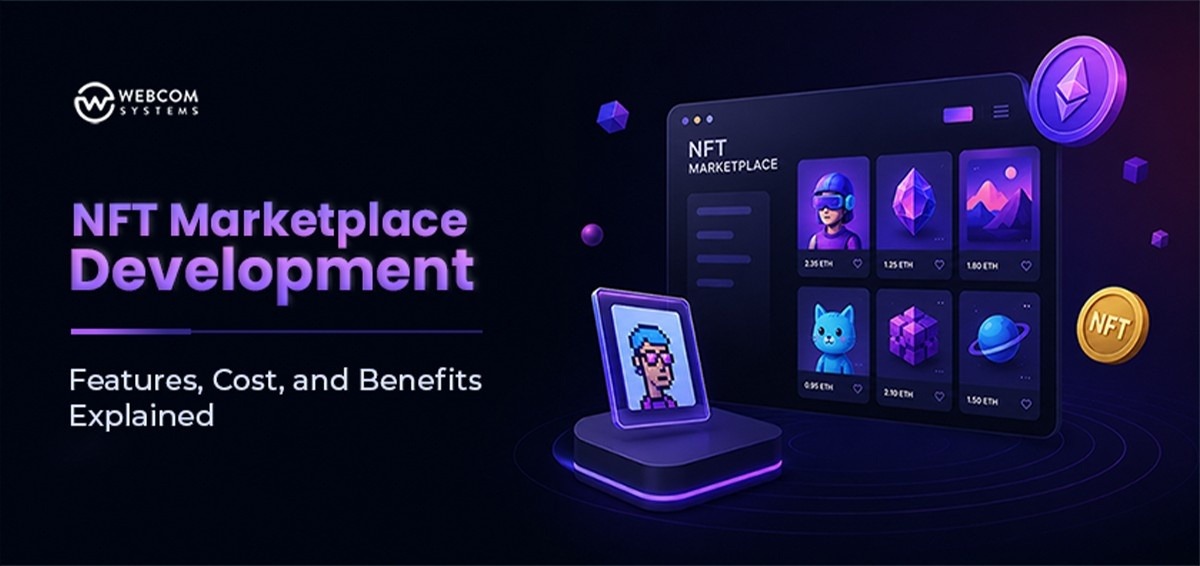
Basically, NFT marketplace development is the process of creating a blockchain-based digital platform where non-fungible tokens (NFTs) can be minted, bought, sold, auctioned, and traded. These assets could include digital artworks, music or media files, gaming items, collectibles, event tickets, intellectual property rights, virtual real estate, and more.
Unlike traditional assets, the decentralized architecture powering these assets creates an ownership record, and their transactions are managed automatically via smart contracts.
An NFT marketplace is essentially a market, as the name suggests. You can consider how an e-commerce platform that sells physical goods works. But here you can exchange blockchain-based digital assets. These platforms are intelligently designed by employing decentralized networks to create sustainable ecosystems where ownership, community engagement, and monetization can coexist.
Different Categories of NFT Marketplaces
Not all NFT marketplaces are the same. There are different NFT marketplace models in the market, each developed to serve different audiences, use cases, and levels of control. Here are some of the basic types to help you choose the right model before investing in development.
Open NFT Marketplaces
These platforms are open to everyone, from artists to businesses, to create and trade their own NFTs. Some of the examples are OpenSea, Magic Eden, and Rarible.
Curated NFT Marketplaces
Curated marketplaces are extremely selective about how you can use their platform. They uphold strict quality standards and provide an exclusive experience. SuperRare, Nifty Gateway, and Foundation are popular marketplaces in this category.
Niche-Specific Marketplaces
Some marketplaces are created solely to serve a specific industry. Instead of aiming for mass appeal, this allows you to build a specific user base. Platforms such as NBA Top Shot for sports and Audius for music are niche marketplaces.
Hybrid NFT Marketplaces
Hybrid NFT marketplaces provide a balance of curated control, backed by community-led governance, and free participation in open marketplaces. Zora and Foundation are two prime examples.
Decentralized NFT Marketplaces (DAO-Based)
These marketplaces are governed by communities using token-based voting. They are quite difficult to manage but provide transparency and decentralization.
Key Features of NFT Marketplace Platform Development
Let’s explore the key features of an NFT marketplace that make a platform fit to mint, buy, manage, and trade NFTs as well as meet the expectations of modern users:
User Registration and Profile Management
A user journey starts on the marketplace with an onboarding experience. It should be smooth enough to draw in and retain users and strong enough to maintain compliance with necessary regulations. These platforms should also make it simple for users to mint and handle NFTs.
Wallet Integration
Wallet connectivity is the key integration that can help users actually own their NFTs. MetaMask, Coinbase Wallet, Trust Wallet, and even a custom wallet can be chosen to integrate with the wallet.
NFT Minting and Listing
Minting functionality allows creators to convert their assets into blockchain-based assets. A powerful minting module can handle image uploads, video and audio files, metadata creation, and bulk minting. Listing, like minting, must be user-friendly.
Advanced Search and Filtering
NFT marketplaces accommodate a large number of NFTs. Thus, these platforms require an advanced search functionality. This feature is supported by a number of filters, such as Category, Collection, Blockchain network, and more, to simplify discoverability.
Auction and Bidding Systems
An auction is a powerful monetization model in the NFT ecosystem. The marketplace can host various auctions to provide an engaging environment for users.
Smart Contracts
Smart contracts automate NFT creation, ownership transfer, royalty payments, escrow mechanisms, auctions, and a variety of other NFT marketplace operations.
Creator Royalties
NFT marketplaces can automate royalties for creators. Thus, NFT creators can easily earn a fixed percentage from their resale. It can support dynamic pricing strategies and improve revenue distribution across digital ecosystems.
Multi-Chain Support
Modern NFT marketplaces function as ecosystems rather than individual platforms. They operate across multiple blockchain platforms like Ethereum, Polygon, Solana, Avalanche, BNB Chain, and more.
Security and Compliance Features
As security and compliance are important for any digital platform, so too are they for NFT marketplaces. The platform should be built employing smart contract audits, AML compliance, anti-phishing protections, two-factor authentication, and other sophisticated security technologies and compliance frameworks.
Step-By-Step Process: How To Build An NFT Marketplace?
When you choose a professional like Webcom Systems, here’s how they will approach your development project:
Discovery & Planning
The first and foremost step of defining a niche is whether it’s gaming, art, real estate, or else, as well as setting future goals. Following that, blockchain networks and a full tech stack are chosen, and monetization channels are decided upon.
Platform Design
Once requirements are clearly defined, the focus shifts to creating a clean, responsive, and intuitive interface. This includes designing a storefront with NFT listings, a wallet connection flow, and a smooth user experience.
Smart Contract Development
Blockchain developers would perform smart contract development for transactions such as asset minting, transfers, and sales. These smart contracts are then subjected to manual and automated audits to identify and remediate security vulnerabilities.
Core Development
In this phase, the main platform is then developed, integrating both frontend and backend systems with blockchain functionality. This includes building user dashboards, search and filtering systems, and other components into a single marketplace.
Testing & Deployment
Before launching, the platform is thoroughly tested to identify bugs and security flaws and to improve usability. Following optimizations, the platform is finally released on the mainnet.
Post-Launch Support
After launch, the marketplace is analyzed, managed, and optimized for upgrades and fixes.
NFT Marketplace Platform Development Cost 2026
Anyone considering development would first wonder, “How much does it cost to build an NFT marketplace?”
The cost of developing an NFT marketplace can range from $20,000 to $200,000, or more. There is no set price, as the final budget is determined by a number of factors, including the blockchain used, feature set, level of customization, security requirements, and overall platform architecture.
You can launch a marketplace built with white-label solutions or pre-built frameworks to cut development time and costs. A white-label NFT marketplace can cost between $20,000 and $40,000 and be customized for branding and feature tweaks within a few weeks.
However, you might want to go with custom marketplace development services to incorporate a specific feature set and functionalities. Here’s how it can cost:
Basic NFT Marketplace (MVP)
A Basic NFT Marketplace (MVP) with wallet integration, NFT minting, fixed-price listings, user profiles, and other basic features typically costs between $30,000 and $50,000.
Advanced NFT Marketplace
A fully featured marketplace with added capabilities such as auction systems, advanced search and filtering, royalty distribution, multiple wallet support, etc. generally falls in the range of $50,000–$120,000.
Enterprise NFT Marketplace
An Enterprise NFT Marketplace with sophisticated features like AI/VR connectivity, high-level security protocols, compliance controls, and large-scale infrastructure can cost anywhere from $120,000 to $200,000+.
What Are the Benefits of NFT Marketplace Platform Development?
Indeed, developing an NFT marketplace is one big investment. But is it really worth it? Actually, yes! Explore the long-term benefits that outweigh the investment:
New Revenue and Monetization Opportunities
Unlike other platforms, which limit profit to one-time sales. These marketplaces can allow enterprises to earn through multiple revenue opportunities, such as transaction fees, listing fees, premium memberships, Launchpad services, Creator subscriptions, etc.
Global Accessibility
Traditional marketplaces frequently face geographical constraints, which also limit growth. As the product isn’t physical, NFT platforms can smoothly operate globally. Users only require an internet connection and a compatible wallet to participate in the ecosystem.
Enhanced Security
Blockchain-based ownership records provide cryptographic security, which directly reduces the risks of duplication, forgery, and unauthorized asset transfers. Besides, when the marketplace is with the help of a professional blockchain development company like Webcom Systems, advanced security technologies and strong compliance measures can deliver exceptionally secure digital asset environments.
Creator Empowerment
NFT marketplaces allow creators to monetize their assets directly on-chain without relying on intermediaries. Thus, they don’t need to share their profits and profit from automated royalties.
Transparent Ownership Records
Blockchain technology creates immutable transaction histories. This makes ownership verification transparent and tamper-resistant. As a result, it directly increases buyer, seller, and creator trust, as well as platform adoption and growth.
Conclusion
In 2026, NFT marketplaces operate as digital ownership ecosystems, empowering creators, businesses, and consumers to exchange value with the transparency and efficiency of decentralized infrastructure. Building a successful NFT marketplace requires deep technical expertise, from platform design and smart contract development to integrating multi-chain compatibility, creator royalty mechanisms, and more to engineer scalable platform architecture.
Webcom Systems is a globally leading NFT marketplace development company that helps businesses turn their ideas into fully functional marketplaces. We provide end-to-end services assisting with ideation, UI/UX design, custom development, feature integration, testing, deployment, and ongoing post-launch support. Not only this, we even offer white-label NFT marketplace solutions for businesses looking for faster as well as budget-friendly market launches.
Whether you are a gaming company that wants your players to trade in-game assets, a luxury brand that wants to tokenize exclusive experiences, or a real estate platform exploring tokenized ownership, our team can make that happen for you. Get in touch to discuss your project today, and we can deliver custom NFT marketplace infrastructure for your business needs!
Recommended Read: Top NFT Business Models of the Future